Does Walking Help You Sleep? What Japanese Walking Studies Found
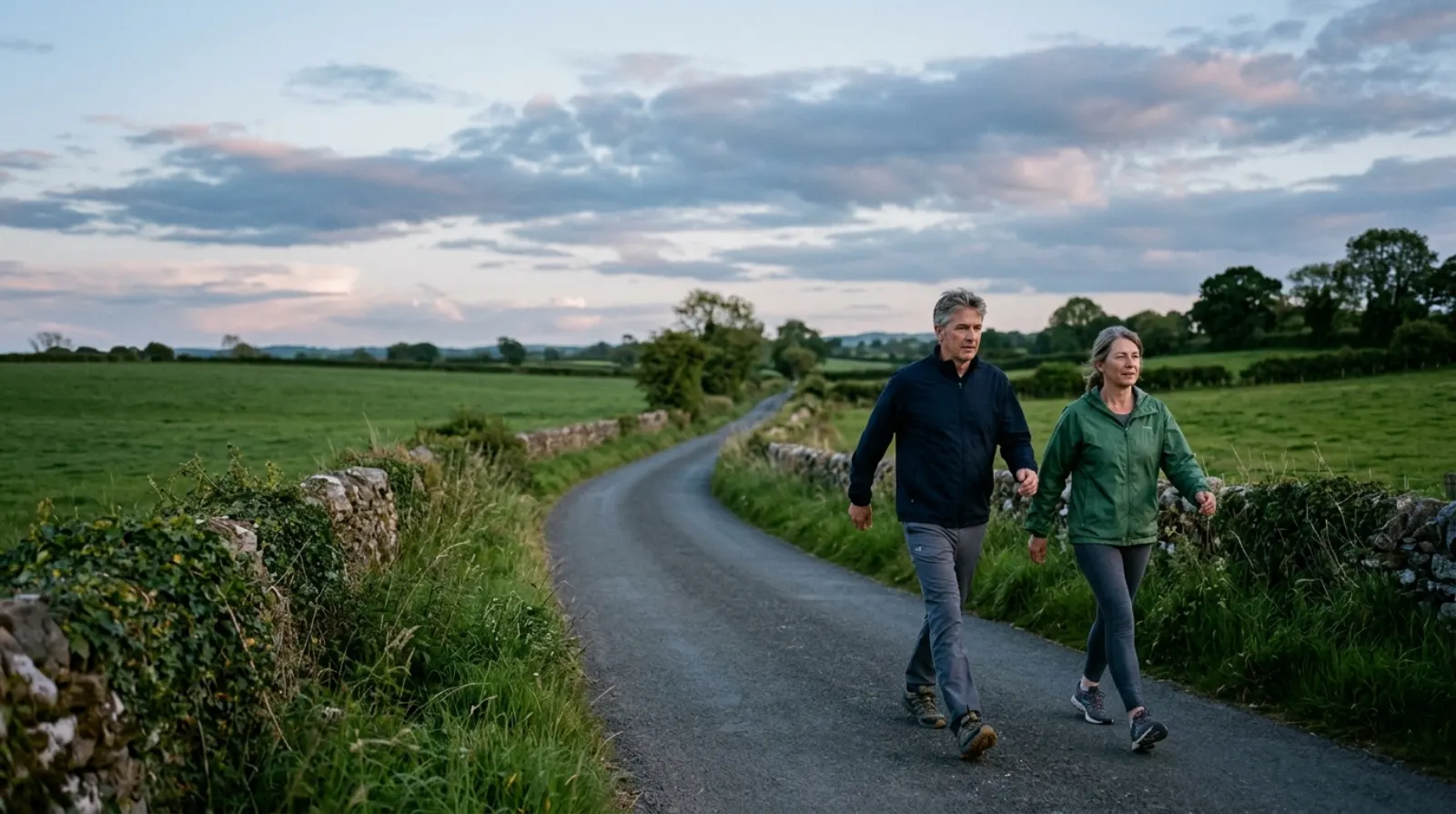
Does walking help you sleep? Regular exercise in general does seem to help a little: people fall asleep somewhat faster and rate their sleep better. But the one study that tested Japanese walking in poor sleepers found no clear change in sleep quality after five months. Here is what the research says, what it does not, and how to walk in a way that is kind to your nights.
What the Japanese walking sleep study found
The most direct test comes from Japan, where interval walking was developed. Kamiya and colleagues followed older adults with poor sleep for five months (Sleep Medicine, 2024, PMID 38692218). Everyone in the study was 65 or older and scored above 5 on the Pittsburgh Sleep Quality Index, a common questionnaire where higher scores mean worse sleep.
One group of 63 people did interval walking training: alternating fast and slow walking, the same idea behind Japanese walking. A control group of 65 people did not. The walkers wore an accelerometer at the waist, so the researchers knew when, how often and how hard they actually walked.
The headline result is honest and a little disappointing: the change in sleep quality score was not significantly different between the two groups, for women or for men. The authors concluded that interval walking training, on its own, does not significantly improve sleep quality.
There was one interesting detail. Inside the walking group, some people did improve compared with where they started: women who exercised 3 to 8 hours before bedtime, men who walked more than 8 hours before bed and more than an hour after waking, and men who walked on about five or more days a week. These were comparisons within one group, so they are a hint about timing, not proof.
What exercise in general does for sleep
Zoom out and the picture is more encouraging. A meta-analysis by Kredlow and colleagues pooled 66 studies on physical activity and sleep (Journal of Behavioral Medicine, 2015, PMID 25596964). For regular exercise, it found:
- small benefits for total sleep time and sleep efficiency (the share of time in bed spent asleep),
- small-to-medium benefits for how quickly people fell asleep,
- moderate benefits for how people rated their sleep quality.
The effects depended on things like age, sex, how active people were to begin with, the type of exercise, the time of day, how long sessions lasted and how well people stuck with them. Intensity was not a significant factor. In other words, it is less about going hard and more about doing it, regularly, at a time that suits you.
Walking specifically has been studied in some groups too. A review of 25 randomized trials with 1,918 participants, mostly people with breast cancer, found that moderate walking improved sleep disturbance more than yoga did (Sleep Medicine Reviews, 2019, PMID 31207341). That is one particular group, so it does not tell you what will happen to you, but it is another sign that ordinary walking is not nothing for sleep.
So does Japanese walking help you sleep?
The fair answer: maybe a little, through the general effect of being more active, but the one trial of interval walking in poor sleepers did not show it. If sleep is your main reason for walking, it is better to expect a gentle nudge than a cure.
That still leaves plenty of reasons to walk. The same research group's main trial found clear gains in fitness and leg strength over five months; our guide to the benefits of Japanese walking covers those. And if you sleep poorly for weeks, that is worth a conversation with your doctor, not just a new routine.
When to walk if you want to sleep well
The timing detail from the Kamiya study is worth taking seriously, even if it is only a hint. A few practical points:
- Earlier is a safe default. Morning, lunchtime or late afternoon walks leave plenty of hours before bed. In the study, the improvements inside the walking group showed up when exercise ended several hours before bedtime.
- If evening is your only time, keep the fast phases earlier in the evening. Notice how you sleep afterwards; some people wind down easily, others feel wired.
- Daylight helps you stay consistent. As days get shorter, an after-work walk drifts into the dark. Our post on Japanese walking in autumn and winter has ideas for keeping the habit through the darker months.
- Regular beats perfect. The meta-analysis found adherence mattered. Three walks a week that you actually do are worth more than a plan you drop.
- Fast does not have to mean exhausting. The fast phase should let you speak a sentence but make you prefer not to. How fast you should walk explains the talk test.
Ayumi times the 3-minute blocks for you, with a vibration and a voice cue at every switch. Its weekly report also shows which part of the day your walks began in, morning, midday, evening or night, so you can see at a glance whether your walks are creeping close to bedtime. Try Ayumi on the App Store.
What we still don't know
There is no large randomized trial yet showing that interval walking improves sleep more than steady walking, or more than no walking at all. The study above was in adults aged 65 and over who already slept poorly, and it did not find an overall effect. Nobody has tested Japanese walking for younger people with normal sleep, for shift workers, or for people with diagnosed insomnia or sleep apnea.
Until that research exists, the reasonable approach is simple: walk for the benefits that are well shown, walk at a time that does not keep you up, and treat better sleep as a possible bonus rather than a promise.
Studies: Kamiya et al., Sleep Medicine, 2024 (PMID 38692218; 128 adults aged 65 and over with poor sleep, 5 months of interval walking training vs control); Kredlow et al., Journal of Behavioral Medicine, 2015 (PMID 25596964; meta-analysis of 66 studies); Sleep Medicine Reviews, 2019 (PMID 31207341; 25 randomized trials, 1,918 participants, mostly people with breast cancer). Cover image: AI-generated. Results vary from person to person. General information, not medical advice; talk to your doctor if you have ongoing sleep problems or a heart condition.